
Criminal Cases in the Fulton County Courts
Fulton County Court is the county's felony trial court. It sits with Supreme Court at 223 West Main Street in Johnstown. New York City and Town Courts may arraign a felony complaint and conduct preliminary proceedings, but an indicted felony moves to County Court. County Court also shares misdemeanor jurisdiction. A misdemeanor can instead remain with Gloversville City Court, Johnstown City Court, or the Town Court that received the accusatory paper. The Fulton County District Attorney's court directory is the strongest county-maintained list for matching a local court to its phone number and sitting schedule.
The court clerk, not the arresting agency, keeps the judicial case file. That point matters when an arrest report and filed charge differ. Police document the initial event. The prosecutor chooses the accusation to file, and the court records each later action. Ask the clerk that owns the docket for inspection, copies, or a certificate of disposition. Fulton County has one County Court, two City Courts, and ten Town Courts, so the correct counter often depends on the first court paper.
Fulton Case Search Has No Portal
No official Fulton County criminal docket portal was located in the research. The County Clerk's SearchIQS service is for recorded property and business instruments. It is not a criminal case search. Free WebCriminal access also has limited participating-court coverage and is not a complete Fulton County case database. A missing online result should therefore lead to a clerk call, not a firm conclusion that no case exists.
Use the court named on an appearance ticket, release paper, prior notice, or certificate. If that document is unavailable, narrow the venue by place and charge level. A Gloversville misdemeanor generally points to Gloversville City Court; a felony indictment points to Fulton County Court. Older files may require staff retrieval from an offline index. Give the clerk the defendant's name, an approximate year, and a docket or indictment number when known. This fallback is slower than a county portal, but it reaches the office with the authoritative file.
Note: SearchIQS subscription fees and land-record hours do not govern criminal docket access at the Fulton County Court clerk's counter.
How to Search Case Records
When the court is known, go straight to its clerk. Use OCA Criminal History Record Search only when a statewide public summary helps locate the court or compare reported public outcomes. OCA CHRS uses an exact name and date of birth, charges $95 for each name and DOB combination, omits sealed cases, and has limits in Town and Village Court reporting. The result is not a certified disposition.
- Read the appearance ticket or prior notice and identify the court of origin.
- Call that clerk with the exact name, approximate year, and case or indictment number.
- Ask whether the file is available for inspection and whether older records need advance retrieval.
- Review the docket for filed charges, status, appearances, disposition, and sentence.
- Request copies or a certificate of disposition from the court that decided the case.
The OCA CHRS program accepts online account requests or its official mail form. The fields below reflect the application. A spelling change, alias, or alternate birth date is a new paid search rather than a broad-match variation.
| Field Label | Type | Required | Notes |
|---|---|---|---|
| Requestor name and address | Text | Yes | Identifies where the result goes |
| Telephone and email | Text/email | Phone yes | Email is needed for email return |
| Subject name | Text | Yes | First and last name must match exactly |
| Alias | Repeated name | No | Each alias costs another search fee |
| Date of birth | Date | Yes | Each alternate DOB is separately charged |
| Return and payment | Selection | Yes | Mail requests need a SASE; no cash by mail |
Fulton Court Clerk Routes
The Supreme and County Court office is open from 9 a.m. to 5 p.m. and lists 518-706-3290 as its main number. It is in the West Main Street court complex. The County Clerk works at the same street address, but the two counters do not serve the same function. A criminal docket or certificate belongs with the Unified Court System clerk that handled the case. The County Clerk's public page includes general fees and recorded-instrument services, which can cause a wrong turn.
The Fourth Judicial District court directory is the source for current Fulton Supreme and County Court hours, contacts, and accessibility arrangements. The Fulton County Clerk page provides useful building context and its own service schedule. The distinction is worth seeing before a visit.
The official Fulton County Clerk source supplied the successful court image below. It shows the county office context connected to West Main Street services.
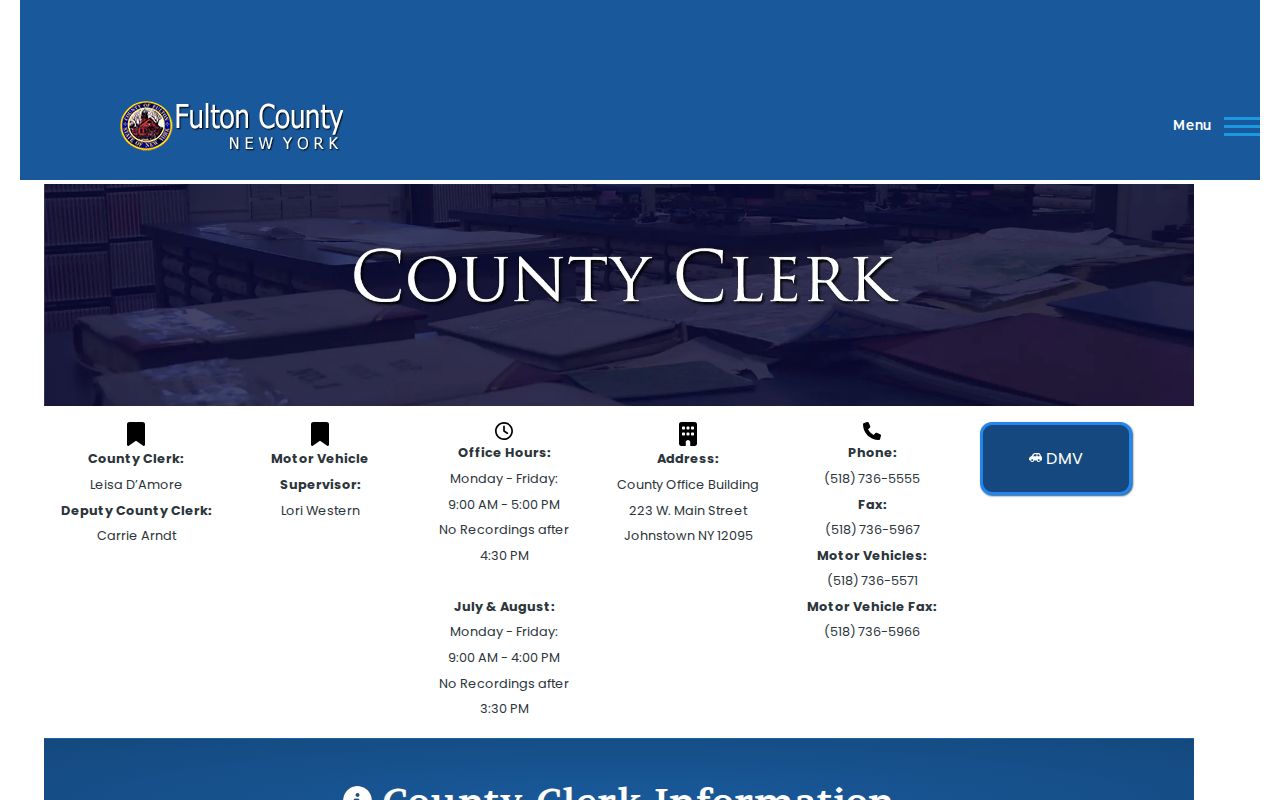
The image reinforces a key routing point: sharing a building does not make the County Clerk the custodian of every criminal court case file.
Fulton County Court
223 West Main Street
Johnstown, NY 12095
518-706-3290
Monday through Friday, 9 a.m. to 5 p.m.
Gloversville City Court
3 Frontage Road
Gloversville, NY
518-706-3320
Listed hours: 8 a.m. to 4 p.m.
What the Case File Shows
A Fulton County criminal case file follows the prosecution, not just the arrest. It can show the accusation filed in court, the appearance history, motions, orders, pleas, trial events, dismissal or conviction, and sentence. A public CHRS summary presents fewer fields and no pleading set. The clerk file may hold the accusatory instrument and other documents that explain why a booking charge changed or why one count ended differently from another.
| Case Number & Court | Identifies the docket or indictment and the court that owns it. |
|---|---|
| Charging Document | Shows the complaint, information, indictment, or superior-court information filed. |
| Docket Entries | Lists appearances, counsel, motions, orders, and other recorded activity. |
| Hearing Dates | Records scheduled or completed hearings and trial events. |
| Disposition & Judgment | States how each filed charge ended and the disposition date. |
| Sentence & Conditions | Records the court-ordered sanction and available sentence terms. |
Private victim details, sealed charges, and other protected identifiers are not public. A certificate of disposition is the court-certified statement of the result. It carries more authority for one case than an uncertified CHRS report.
Fulton Misdemeanor Case Courts
A misdemeanor file may stay in one of twelve lower courts rather than reach County Court. Gloversville and Johnstown each have a City Court. Bleecker, Broadalbin, Caroga, Ephratah, Johnstown, Mayfield, Northampton, Oppenheim, Perth, and Stratford each have a Town Court. These courts also receive felony complaints for arraignment and preliminary action before a felony moves to County Court.
This spread creates a practical search gap. CHRS has limited Town and Village reporting, and a statewide no-record response may not settle whether a local court has a file. Use the live Fulton court roster to confirm the clerk, current phone, address, and sitting day. For records tied to the two incorporated cities, the Gloversville and Johnstown clerks remain separate custodians. A lower-court disposition should be requested from that lower court.
Exact-match limit: OCA CHRS does not combine aliases or birth-date variations, and sealed matters are intentionally excluded from the public result.
Stages of a Criminal Case
A New York case can begin with an arrest or appearance ticket. Arraignment follows without needless delay. Fulton County uses a Centralized Arraignment Part inside the county jail for off-hours arraignments, then routes the matter back to its proper City, Town, or County Court. A misdemeanor proceeds on a complaint or information. A felony begins in lower court, then may move by grand jury indictment or waiver of indictment to a superior-court information.
Case flow: Charges Filed › Arraignment › Pretrial › Plea or Trial › Disposition › Sentencing
Discovery and motions build the docket between arraignment and resolution. A plea, verdict, or dismissal produces the disposition. Sentencing follows a conviction, and an appeal may create a related record in another court. Each step can alter the status shown in the file. For arrest-stage context before charges are filed, Fulton County's arrest history channels explain the agency and custody records that precede the docket.
Fulton Case Certificates at West Main
A certificate of disposition is the best request when the exact outcome matters. It is a court-issued, case-specific statement of what happened. Start with the court of original jurisdiction and provide the name plus the docket or indictment number. Ask whether the file must be pulled in advance, what copy or certification charge applies, and what form of payment the clerk accepts. The research found a general County Clerk schedule listing $5 for an issued disposition and $5 for a certified copy, but it did not confirm that those amounts govern the criminal court counter. Verify the criminal-court fee before sending payment.
CHRS works differently. It searches reported public court data across the state and can reveal the court and outcome fields received by OCA. Its $95 charge applies to each exact name and DOB combination. The report itself is uncertified. If CHRS shows a Fulton result that must be proven or corrected, take its court and case identifiers to the originating clerk. If the case is old, allow time for archive retrieval.
Access & Restrictions
Public access depends on the record and its status. New York courts administer judicial files, while the New York Freedom of Information Law applies to agency records. A Sheriff's FOIL request is therefore not a substitute for a court-file request. Public Officers Law section 87 permits agency withholding for listed exemptions, and separate court rules govern judicial access. Sealed cases, youthful-offender matters, juvenile files, protected victim information, and some private identifiers do not belong in ordinary public results.
A file that does not appear online may be sealed, offline, too new for a data feed, outside a participating court, or indexed under an exact spelling. Call the clerk before drawing a conclusion. If a public summary lacks a final disposition, obtain the certificate from the court and use the correction route appropriate to the product. The New York State Division of Criminal Justice Services handles corrections to a person's fingerprint-linked rap sheet, while the court clerk controls its own case record.
Note: A public court file records allegations and proceedings; only its disposition shows whether a filed charge ended in conviction, dismissal, or another result.
Older Fulton Court Case Files
Older Fulton County criminal case records may sit outside current online indexes. Begin with the court that handled the matter and give a narrow date range. A docket number, indictment number, former name, or known charge can help staff find the file. Ask whether the case is stored off site, whether inspection needs an appointment, and whether a certificate can be prepared by mail. No official source reviewed promises a fixed retrieval time.
A broad request for every related record can also cross office lines. The police report stays with the arresting agency. County custody information stays with Fulton Corrections or VINE. The court file stays with the clerk, and a fingerprint-based state history stays with DCJS. For an old case, use the court certificate as the anchor document. It can then support a challenge when another official record has a missing or wrong disposition.